
Furniture and Interior Design Trends for January 2026: Colors, Fabrics, and Spatial Approaches
Short Answer:
By January 2026, furniture and interior design trends are shaped around natural yet rich color palettes, sustainable and high-performance fabrics, modular office systems, and a hybrid design approach that integrates living spaces with offices.
Key Dynamics Shaping Furniture and Interior Design Trends in 2026
The year 2026 is considered a significant turning point in both the residential and office furniture sectors. The permanent adoption of remote and hybrid work arrangements following the pandemic, changing consumer behavior due to global inflation, and the pressure for sustainability have led designers, manufacturers, and interior architects to develop more rational solutions.
The key dynamics that stand out as of January 2026 are as follows:
- The increasing demand for durable and modular furniture.
- Design approach sensitive to raw material costs.
- The blurring of lines between home and office.
- Spaces focused on acoustics, ergonomics, and health.
- A combination of visual simplicity and tactile richness.
Being on trend in 2026 means being advantageous not only aesthetically, but also in terms of cost, sustainability, and lifespan.
2026 Furniture Trend Colors
1. Natural and Saturated Earth Tones
In 2026, pastel colors will be replaced by richer, nature-inspired hues. These colors create a sense of trust, balance, and timelessness in both commercial and residential projects.
| Colour | Area of Use | Design Effect |
|---|---|---|
| Earth Coffee | Executive desks, cabinets | Trust and authority |
| Olive | Lounge and waiting areas | Calmness and naturalness |
| Clay Tiles | Wall panels | Warmth and character |
2. Cool Neutral Colors and the New Minimalism
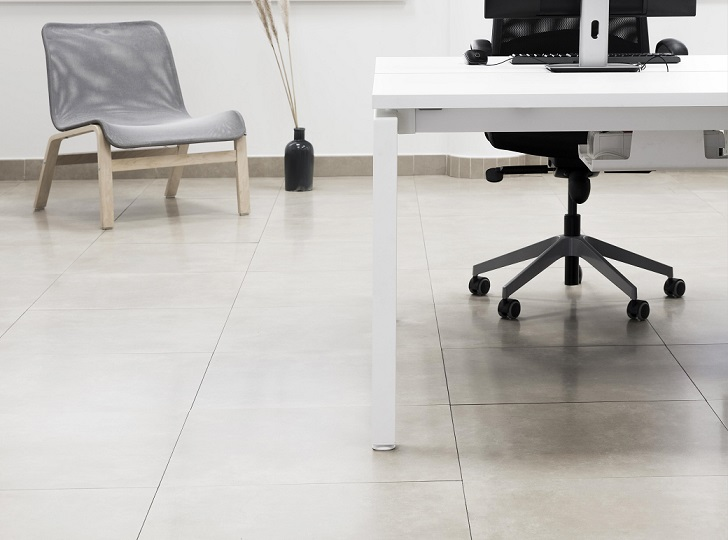
Minimalism has evolved into a warmer form in 2026. Instead of pure white, shades of ash white, light gray, and cool beige are preferred.
- Graphite grey: A professional look for corporate offices.
- Ash white: A refreshing color for open-plan offices.
- Cool beige: Balance in home-office hybrid spaces.
2026 Fabric and Upholstery Trends
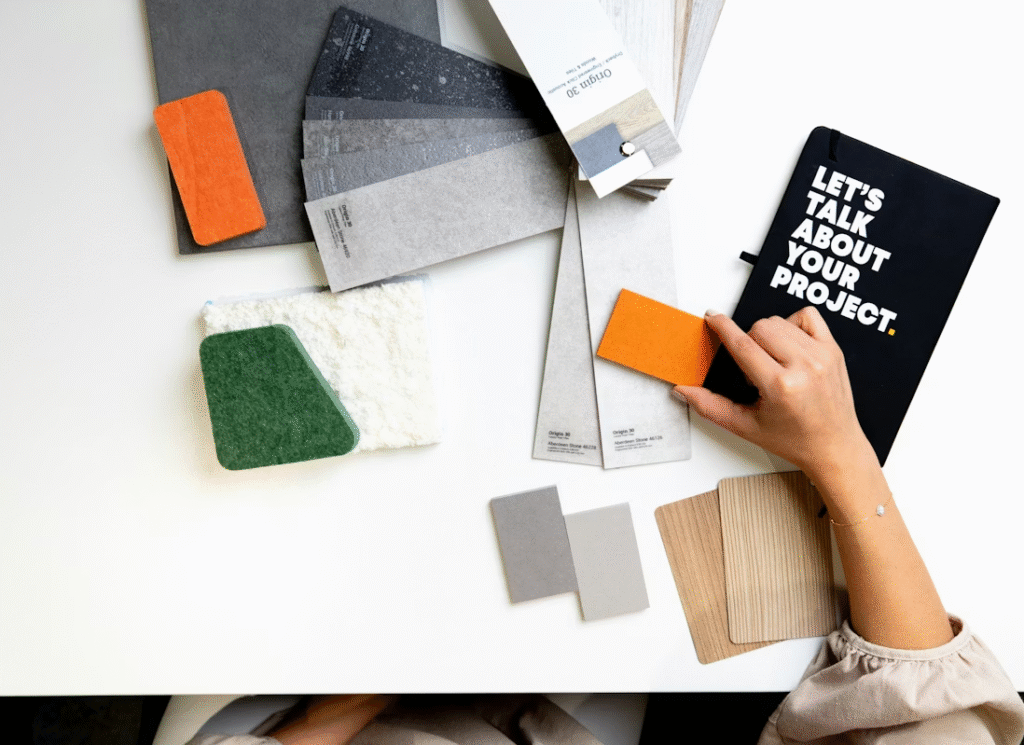
Furniture fabrics will be evaluated not only on aesthetics but also on performance, hygiene, and acoustic properties in 2026.
Featured Fabric Types
| Material | Feature | Area of Use |
|---|---|---|
| Textile-Look Polyester | Stain-resistant, durable. | Office chairs |
| Bouclé | Textured, warm | Home office spaces |
| Acoustic Felt | Sound absorber | Meeting rooms |
| Vegan Leather | Sustainable | Executive chairs |
Acoustic fabrics, in particular, have become standard for noise control in open-plan office environments.
2026 Office Furniture Trends
Modular and Convertible Systems
Modular systems, capable of meeting the needs of companies for rapid growth or downsizing, are the strongest office furniture trend of 2026. Fixed and heavy systems have given way to portable, expandable, and detachable structures.
- Modular work desks
- Height-adjustable leg systems
- Freestanding acoustic panels
Acoustically Focused Office Design
In offices of 2026, silence is no longer a luxury, but a necessity. Telephone booths, semi-enclosed workspaces, and sound-absorbing surfaces have become standard.
2026 Living Space Furniture Trends
Office ergonomics in home furniture, office furnitureIn contrast, home comfort has come to the forefront. The line between these two areas has largely been blurred.
- Multifunctional furniture
- Soft edges and organic forms
- Space-saving storage solutions
2026 Material Trends
Cost and environmental impact are just as important factors in material selection as aesthetics.
| Material | Why is it preferred? |
|---|---|
| Natural Veneer MDF | Sustainable and economical |
| Matte Metal Legs | Timeless industrial style |
| Recycled Plastic | Environmentally friendly production |
Frequently Asked Questions (FAQ)
What are the most popular furniture colors in 2026?
Earth tones, olive green, and cool neutral colors are the most popular colors of 2026.
Which fabrics are preferred for office furniture in 2026?
Acoustic felt, textile-look polyester, and vegan leather stand out.
Are 2026 furniture trends expensive?
No. Trends are shifting towards more durable, modular, and cost-performance-oriented solutions.
2026 Global Interior Design Trends Analysis: What's Happening in the World?
As we enter 2026, the furniture and interior design sectors are being shaped not only by aesthetic trends but also by economic, sociological, and technological transformations. An examination of European, Far Eastern, and American markets reveals a common trend: less production but higher quality. This approach necessitates more efficient use of square footage in both residential and office projects.
In the European market, Germany, Italy, and the Scandinavian countries in particular have focused on simple forms, durable materials, and modular systems. In the Far East, the design philosophy centered in Japan and South Korea produces solutions that offer maximum functionality in minimal spaces. Chinese manufacturers, on the other hand, are rapidly scaling up global trends based on the cost-performance balance.
In 2026, catching up with global trends doesn't mean copying them exactly; it means adapting them to local needs.
Distinguished Trends for Office, Residential and Commercial Spaces in 2026
The 2026 Approach to Office Spaces
Offices are no longer just workspaces; they are the physical reflection of corporate identity. In 2026, employee experience will be a key focus in office design. The disadvantages of open-plan offices have become clearer; quiet workspaces, focus booths, and acoustic solutions have become standard.
- Flexible layouts suitable for hybrid work arrangements.
- Tables with adjustable height
- Acoustic fabric-covered partitions
- Semi-transparent panels that do not block natural light.
Residential and Home-Office Areas
The most prominent theme in 2026 housing trends is the multifunctional use of homes. The boundaries between living room, workspace, and relaxation area have blurred. This makes ergonomics and compact design essential in furniture selection.
Folding desks, wall-mounted storage systems, and furniture that provides an office feel when needed without disrupting home aesthetics are prominent features.
Commercial Spaces and Showrooms
The 2026 trend for stores, showrooms, and common areas is to create a simple yet powerful atmosphere that doesn't overwhelm the user. Furniture has become less the star of the space and more an element that complements the experience.
Color Psychology and Sectoral Usage Scenarios for 2026
Color choice in 2026 will not be just an aesthetic preference; it will be a strategic decision influencing user behavior.
| Color Group | Psychological Impact | Suggested Area |
|---|---|---|
| Earth Tones | Trust, stability | Executive offices |
| Shades of Green | Calmness, balance | Waiting areas |
| Grey & Neutrals | Professionalism | Open offices |
| Hot Tile | Energy, character | Social areas |
Thanks to this approach, spaces become not only beautiful but also functional.
2026 Fabric and Material Technical Comparisons
In 2026, fabric and material selection will be evaluated based more on lifespan and maintenance costs than on the product's selling price.
| Material | Advantage | Disadvantage | Suggested Use |
|---|---|---|---|
| Acoustic Felt | Sound insulation | Limited colors | Open office |
| Bouclé Fabric | Warm tissue | Spot sensitivity | Home office |
| Vegan Leather | Sustainable | Air permeability | Administrative area |
| Textile Polyester | Resistant | The natural feeling is minimal. | Heavy use |
In 2026, the best fabric won't be the most expensive, but the one best suited to the intended use.
Predictions for 2026–2028: What Will the Coming Years Bring?
2026 is just the beginning. Over the next two years, the following trends are expected to strengthen in furniture and interior design:
- AI-powered personalized furniture production.
- Making low carbon footprint materials mandatory
- Design solutions tailored for small square footage.
- Rental and subscription models for furniture.
Therefore, designers and companies following the 2026 trends are planning not only for today but also for the path to 2030.
Conclusion: What Should Furniture and Interior Design Look Like in 2026?
By January 2026, success in furniture and interior design will depend not on chasing fleeting trends, but on accurately analyzing changing lifestyles. Colors will be calmer, fabrics more durable, and designs more flexible and long-lasting.
Whether for offices, residences, or commercial spaces, the winning projects of 2026 will be those that strike a balance between aesthetics and functionality.