








Furniture Materials: What Are Particle Board, MDF, Melamine, Solid Wood, and Lacquer?
When choosing office furniture, the material names you encounter can be confusing. Terms like particle board, MDF, melamine, solid wood, and lacquer directly affect the quality, durability, and aesthetics of the furniture. In this comprehensive guide, we will examine in detail what each material is, its advantages and disadvantages, and its purpose in office furniture. Choosing the right material ensures your office is both long-lasting and professional-looking.
What is Particle Board?
Particle board, technically known as chipboard, is a panel produced by pressing waste materials such as wood chips, shavings, and sawdust with synthetic resins. In the production process, wood residues are broken into small pieces, dried, mixed with glue and binders, and pressed into panels at high temperatures. Particle board is commonly used in economical furniture production due to its low cost. However, because of its low density, its screw-holding capacity is limited, and it is sensitive to moisture. When in contact with water, it has a high risk of swelling and disintegrating. In office furniture, it is generally preferred for non-load-bearing parts such as back panels, shelf bases, or low-cost desk carcasses. Particle board panels are often used with surface coatings (laminate, melamine) to increase durability.
What is MDF?
MDF stands for Medium Density Fiberboard. It is produced from wood waste like particle board, but this time the wood fibers are broken down more finely and pressed with resin. MDF has a much higher density than particle board, giving it a smoother surface and a more homogeneous structure. MDF has better screw-holding capacity than particle board, and its edges can be cut more cleanly. Its resistance to moisture is better than particle board, but it is not completely waterproof. In office furniture, MDF is typically used in places requiring higher quality and smooth surfaces, such as desktops, drawer fronts, doors, and decorative panels. It provides an ideal base for paint and lacquer applications. Additionally, MDF surfaces can be coated with veneer or melamine to create a product similar to melamine-faced chipboard.
What are Melamine-Faced Chipboard and MDFLAM?
Melamine-faced chipboard is particle board coated with decorative paper impregnated with melamine resin. This coating gives the particle board an aesthetic appearance and increases its resistance to scratches, stains, and moisture. Melamine-faced chipboard is one of the most commonly used materials in office furniture. It offers various decor options such as wood patterns, solid colors, and metallic effects. Due to its affordability and wide color range, it is especially preferred in mass office furniture production.
MDFLAM is MDF coated with melamine paper. It offers a smoother surface than melamine-faced chipboard, and the edge banding process yields higher quality results. MDFLAM is more durable than melamine-faced chipboard and has higher screw-holding capacity. In office furniture, it is frequently used for desktops, cabinets, and drawers where a modern and stylish appearance is desired. Both materials can be produced in compliance with E1 class (low formaldehyde emission) standards and are suitable for healthy office environments.
What is Solid Wood?
Solid wood is solid timber obtained by cutting a single piece of natural log without any processing. It is produced from different tree species such as oak, walnut, beech, and maple. Solid wood is the most prestigious option among furniture materials due to its natural texture, unique grain patterns, and long-lasting structure. It offers high durability, robustness, and repairability. Scratches or damage can be removed by sanding and refinishing. However, solid wood is an expensive material and is sensitive to moisture and temperature changes; it can expand and contract. In office furniture, solid wood is generally used for executive desks, meeting tables, bookcases, and custom-designed furniture. It provides a natural and luxurious appearance.
What is Wood Veneer?
Wood veneer is a thin layer of wood, 0.5-3 mm thick, obtained from solid timber. This thin layer is typically glued onto the surface of a base material such as MDF or particle board. The purpose is to offer the natural and aesthetic appearance of solid wood more economically. Veneer carries all the natural grain patterns and color tones of solid wood. In office furniture, it is preferred in projects where a solid wood look is desired but budget constraints exist. Veneered furniture is lighter, more stable (does not expand/contract), and more economical than solid wood. When applied correctly, it can be difficult to distinguish from solid wood. However, the veneer surface is sensitive to deep scratches, and repair is more difficult than with solid wood.
What is Lacquer?
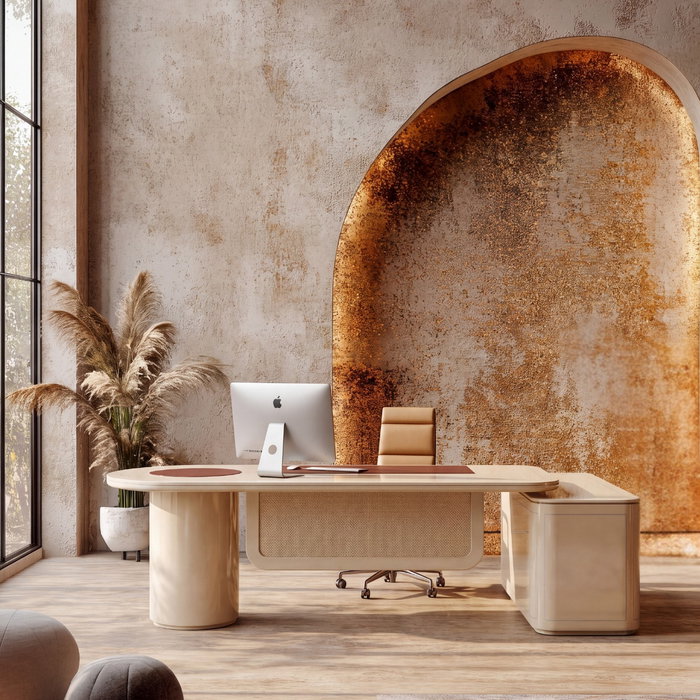
Lacquer is a surface coating technique consisting of paint and varnish layers applied to a furniture surface, resulting in a glossy, matte, or semi-matte finish. Lacquer application is usually done on materials with smooth surfaces such as MDF or melamine-faced chipboard. The process involves several stages: sanding, primer, paint, and topcoat varnish. Lacquered surfaces give furniture a smooth, homogeneous, and modern appearance. Color options are unlimited; any desired color can be applied as lacquer. In office furniture, lacquer is used especially in modern and minimalist designs, reception desks, executive desks, and decorative panels where glossy surfaces are preferred. Lacquered surfaces are highly resistant to stains, moisture, and scratches. However, they have the potential to show fingerprints and may yellow over time. A high-quality lacquer application extends the life of the furniture and increases its aesthetic value. At Kavela, we use first-class E1 class materials in your office furniture and offer both healthy and aesthetic solutions with solid wood and lacquer options.
MDF vs. Particle Board vs. Solid Wood: Comparison
Choosing the right material directly affects the performance and lifespan of your office furniture. The table below compares the three main material types to help you make a decision.
| Material | Durability | Moisture Resistance | Price | Usage |
|---|---|---|---|---|
| Particle Board | Low-Medium (Weak screw holding, brittle) | Low (Contact with water causes swelling) | Low (Economical) | Back panels, shelf bases, low-cost carcasses |
| MDF | Medium-High (Good screw holding, sturdy) | Medium (Moisture resistant, not waterproof) | Medium (Affordable) | Desktops, drawer fronts, doors, lacquer applications |
| Solid Wood | High (Very sturdy, repairable) | Medium (Can expand/contract) | High (Expensive) | Executive desks, meeting tables, custom designs |
Summary: If your budget is limited and the furniture will carry light loads, choose particle board; if you want a higher quality surface and durability, choose MDF; if you seek prestige and longevity, choose solid wood.
Which Material for Office Furniture?
The material decision in office furniture selection varies according to the purpose of use, budget, and aesthetic expectations. Here are material recommendations for different office areas:
- Executive Offices: For prestige and luxury appearance, solid wood or lacquer-coated MDF is ideal. Solid wood offers natural warmth and sturdiness, while lacquered surfaces add a modern and professional touch.
- Open Office Areas: For durable and economical solutions resistant to heavy use, melamine-faced chipboard or MDFLAM should be preferred. These materials are resistant to scratches and stains.
- Meeting Rooms: For a stylish and durable table, lacquered MDF or solid wood veneered MDF is suitable. Stain-resistant surfaces provide an advantage during long meetings.
- Reception Areas: For first impressions, lacquered surfaces or solid wood details can be impressive. Durability and aesthetics are sought together.
- Storage and Archive: For bookshelves and cabinets, melamine-faced chipboard is economical and functional. For shelves that will carry heavy loads, MDFLAM is safer.
At Kavela, we use first-class E1 class materials in your office furniture and offer both healthy and aesthetic solutions with solid wood and lacquer options. We help you make the right choice with material consultancy tailored to each project.
Frequently Asked Questions
Is particle board or MDF better for office furniture?
MDF is denser, smoother, and more durable than particle board. It has high screw-holding capacity and is more resistant to moisture. In office furniture, especially for surfaces like desktops and drawer fronts, MDF is preferred over particle board. Particle board is more economical and can be used in areas that carry less load, such as back panels and shelf bases. For long-lasting office furniture, MDF is recommended.
Is lacquered furniture or solid wood more durable?
Both materials are durable, but in different ways. Solid wood is more resistant to physical impacts, and scratches can be removed by sanding. Lacquered surfaces provide high protection against scratches, stains, and moisture, but deep scratches cannot be repaired. Solid wood is more long-lasting and repairable, while lacquered surfaces offer a more modern appearance. The choice depends on the purpose of use and aesthetic preference.
What does E1 class material mean and why is it important?
E1 class is a European standard that determines the formaldehyde emission level of wood-based panels (particle board, MDF) used in furniture production. E1 class means low formaldehyde emission and offers safe use that is not harmful to human health. To maintain air quality in enclosed spaces like offices, E1 class materials should be preferred. At Kavela, we create healthy office environments by using first-class E1 class materials in all our products.
Related Material Guides
- MDF vs. solid wood?
- Natural wood furniture and tree species
- What is genuine leather?
- Office chair material guide (fabric, leather, mesh)
- Solid wood collection · oak · walnut · lacquered furniture
For custom-sized production with the right material, check out our Ankara office furniture collection and catalog.
Latest posts
@kavelafurniture