








Workstations
No products in this category yet.
You are buying a block, not a table
Workstations are multi-user desk systems that put several people on one shared spine in an open-plan office. If you need a single top for one person, this is the wrong category and desks is the right one. Products here publish their sizes as blocks rather than as single tops. Steel is built around a support structure that combines spine and desk functions for open offices; Planet follows the same modular logic. The decision made on this page is a floor plan, not a piece of furniture: settle the island size first and the product choice narrows on its own.
Read more Show less
How to read a two, four or six-person size
There is a simple way to decode these dimensions. Polo’s single 140x80x75 cm top becomes a facing four-person island at 280x160x75 cm. Planet R lists its 120×70 top alongside 240×140 and 280×140 cm four-person blocks. Steel and Evol offer combinations from 120×140 up to 180×160 cm, where the second figure is the combined depth of two facing rows. Sail and Planet come as 200x100x75 cm single tops that are repeated to form a run. Net top width per person in this category runs between 120 and 200 cm: 120 cm for dense islands, 200 cm where you can afford generosity.
Shared spine, divider panel and cabling
What separates a workstation island from a row of separate desks is the shared structure. The Steel spine carries the tops and routes the cabling at the same time, which is why the power feed for a four-desk island can often be planned from a single point. Slide’s cable management system supports the same block logic. A divider panel between two facing users provides the visual break that open-plan layouts depend on; without it, perceived distance between colleagues collapses. On the base side, Polo, Planet R, Sail and Steel use metal frames with fixed legs, while X-3 uses tapered legs and leaves the underside clear. X-3 and X1 are listed on the Premium line and do not appear as cards in this grid, which shows eight systems.
Storage lives under the island
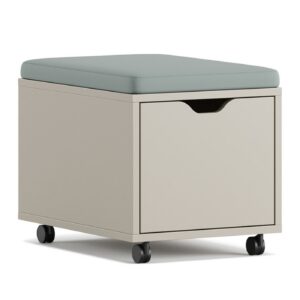
In a block layout, storage goes underneath rather than beside. The Cage pedestal is 42x55x62 cm, low enough to sit under a 75 cm top and mobile enough to be pulled out when the layout changes. Calculate how many pedestals an island takes from the net clearance under the tops, not from the number of desks, because a panel-based system narrows that clearance considerably. If the layout changes often, the castor base options under mobile tables will serve you better.
When to leave this category
If a team leader sits in the same room, give them a separate top from the mid-level executive desks band rather than enlarging one desk inside the block. If team meetings happen at the end of the island, a proper long top from meeting tables will serve better. To introduce standing work into the block, height-adjustable desks can be mixed into the same layout. Everything else sits under tables.
Latest posts
@kavelafurniture