






22 July 2026
Guide to Integrating LED Lighting into Furniture
Proper Use of LED Lighting in Office Furniture. LED lighting integrated into office furniture directly affects the ambiance and user comfort...
Proper Use of LED Lighting in Office Furniture
LED lighting integrated into office furniture is a detail that directly affects the ambiance of the space and user comfort. Incorrect Kelvin selection, distracting glares, or unsuccessful cable management can make a professional design ordinary. In this guide, we address the technical details of LED integration in various furniture types, from executive desks to reception counters.
Lighting Strategy for Executive Desks
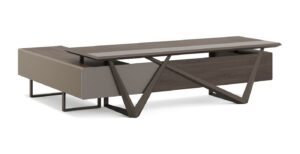
Lighting in executive desks should offer both prestige and functionality. To provide an illumination level of 500 lux on the desk surface, neutral white LED strips in the 4000K-4500K range are generally preferred. This value reduces eye strain while ensuring clear readability of documents. For LED profiles mounted under the desk, it is recommended to use a 30-degree optical angle to prevent light from directly hitting eye level. As seen in models like Turn Me, LED profiles embedded in a 10 mm deep channel opened under the desk surface indirectly illuminate the environment by reflecting light onto the floor, creating a professional ambiance.
Under-Shelf and Bookshelf Interior Lighting
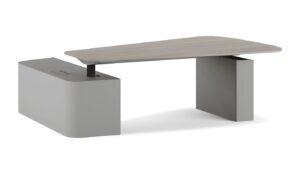
The use of LEDs in storage units is critical for emphasizing the depth of the interior space and easily finding desired items. For under-shelf lighting, 8 mm or 10 mm high aluminum profiles suitable for the shelf thickness are used. The diffuser of these profiles distributes light homogeneously, preventing glare. In bookshelf applications, 1 meter of LED strip per shelf is sufficient, and the strip’s power should not exceed 14.4 W/m. In wide-surface desks like Sun, 2700K warm white LEDs placed under the shelf highlight the wood texture, creating a warm reading area. Drilling 20 mm diameter holes behind the shelf for cable routing eliminates the problem of visible cables.
Impressive Lighting for Reception Counters
Reception areas are first impression points that reflect brand image. LED lighting used on the front face of the counter determines the character of the space. Here, warm tones between 3000K-3500K are preferred, while the light intensity should be kept around 300 lux. As in the Starlight model, IP20 protection class LED strips placed on the lower edge of the counter create a beam of light directed towards the floor. In this application, mounting the strip 5 cm inwards ensures soft light diffusion. Concealing drivers in a ventilated compartment within the counter is important for heat management; a 24W driver is sufficient for a 60 cm counter.
Kelvin Selection and Color Temperature Harmony
Choosing the correct color temperature in office furniture increases work efficiency. As a general rule:
- Task lighting (desk surface): Neutral white between 4000K-5000K. This value improves reading and writing performance by increasing contrast.
- Ambient lighting (shelf, display cabinet): Warm white between 2700K-3000K. Creates a relaxing atmosphere and shows the furniture material’s color naturally.
- Accent lighting (reception, decorative): Between 3000K-3500K. Adds depth to the space and highlights areas intended to attract attention.
For example, the product named Warm, as its name suggests, has a design compatible with 2700K warm LEDs and provides a natural integrity when used with wooden furniture.
Driver Concealment and Cable Management Techniques
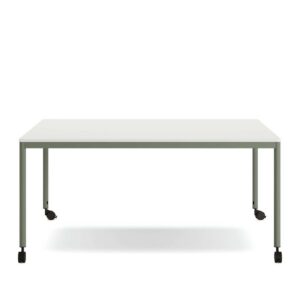
Concealing LED drivers and cables is essential for a professional appearance. Drivers should be placed in a ventilated compartment measuring 15×15 cm, opened under or on the back surface of the furniture. The internal temperature of the driver compartment should not exceed 45°C; therefore, air holes with a minimum diameter of 5 mm are opened on the compartment. For cable management, 20 mm wide cable channels are used, and these channels are covered with caps matching the furniture color. In modular systems like Tupla, pre-prepared 25 mm diameter holes are available for cable routing, and these holes are covered with plastic caps to achieve an aesthetic look.
Practical Application Suggestions
Some technical points to consider in LED integration are:
- Strip length: Voltage drop occurs in strips longer than 5 meters; in this case, a separate driver should be used every 5 meters.
- Cutting points: LED strips should be cut at the copper contact points, and the end part should be sealed with silicone after cutting.
- Diffuser selection: Opaque diffusers soften light by 30%, while transparent diffusers operate with 95% efficiency. Opaque diffusers should be preferred in narrow spaces like bookshelves, and transparent diffusers in wide areas like under desks.
In industrially designed furniture like Pipes, using 1 mm thick aluminum spacers for LED profiles to match metal surfaces prevents vibration and heat transfer.
Conclusion
The integration of LED lighting into furniture is possible with correct Kelvin selection, appropriate profile usage, and organized cable management. Temperature values of 4000K for executive desks, 2700K for under shelves, and 3000K for reception counters create an atmosphere suitable for the function of the space. Concealing drivers in ventilated compartments and matching cable channels to the furniture color are fundamental for achieving a professional result. When these principles are followed, office furniture achieves both aesthetic and ergonomic lighting levels.