







6 September 2026
The Psychology of Space: Cognitive Load, Colour, Ergonomics
A sourced review of cognitive load, attention restoration, colour and ergonomics in interiors, stating separately what each industry figure measures.
How a space looks is an aesthetic decision; how it performs is a measurable one. Environmental psychology joins the two: visual order, light, colour and seating layout act directly on attention, decision-making and fatigue. This report sets out the established frameworks of design psychology and states, separately, what each industry figure actually measures. No productivity percentage is given; the reason is explained at the end.
Executive summary
- Visual clutter is not a matter of taste but of capacity. The brain continuously filters irrelevant detail simply to read a room, and that filtering draws on the same resource as problem-solving and memory.
- Attention Restoration Theory holds that the directed attention required for sustained focus is a depletable resource, and that natural stimuli allow it to recover. Biophilic design is the architectural application of that theory.
- Don Norman’s three levels (visceral, behavioural, reflective) explain why a furniture decision cannot be reduced to appearance: usability and belonging operate at separate levels.
- In ergonomics the decisive factor is attention rather than comfort: physical discomfort makes the brain allocate processing capacity to pain signals.
- Industry figures cannot be read as a single market size. Global furniture production stood at $768.36 billion in 2024; the $26-34 billion figures circulating under the heading “luxury furniture market” are separate series with different definitions, most of them from paid research reports.
- In Türkiye, 2024 production was $17.8 billion and the domestic market $23.8 billion; exports account for only 14.7 % of production. The sector remains largely dependent on domestic demand.
Cognitive load: why a room tires you
Environmental psychology examines the two-way interaction between people and their physical surroundings. The brain continuously scans the environment for signals of safety, predictability and control, and this scanning runs through the autonomic nervous system without being chosen.
The key concepts are cognitive load and processing fluency. Visual clutter, chaotic layout, excessive contrast and exposed cabling force the brain to filter irrelevant detail merely to make sense of the room. While the prefrontal cortex is occupied with visual noise, less capacity remains for problem-solving, memory and creative work. The result is a fatigue that accumulates across the day: every visible object in a poorly structured room demands an unconscious evaluation.
Evolutionary psychology contributes Prospect-Refuge Theory. People prefer positions from which they can observe their surroundings without being observed from behind. A desk with its back to the main circulation route runs against that preference and holds the user in a low-level state of alertness. The practical response is straightforward: back to a wall, a high divider or a cabinet run; in an open plan, an acoustic panel or planting that interrupts the line behind the seat.
Attention restoration and biophilic design
Attention Restoration Theory (ART), developed by Rachel and Stephen Kaplan, argues that the directed attention needed for concentrated work is a limited resource. Natural stimuli engage involuntary attention, and that effortless engagement allows directed attention to rest.
Biophilic design is the architectural application of this theory: daylight, organic curvilinear forms, indoor planting, natural material texture. In an office it comes down to three items. First, light: matching desk layout to the surfaces that receive daylight. Second, breaks: placing the kitchen and washrooms a short walk away rather than adjacent to the desks. Third, texture: visible timber grain, textured fabric and matt metal in place of uniform laminate.
Emotional design: Don Norman’s three levels
The cognitive scientist Don Norman separates responses to objects and spaces into three levels. No framework explains better why a furniture decision cannot be settled with “I like it”.
- Visceral level. The immediate, subconscious response: volume, proportion, light, the visual noise of first impression. The consistent finding that curvilinear spaces are experienced as calmer than rectilinear ones operates here.
- Behavioural level. Use: ergonomics, circulation, acoustic privacy, adjustability. The perceived control given by adjustable lighting or modular furniture sits at this level and relates directly to job satisfaction.
- Reflective level. Meaning and identity: how the furniture relates to corporate identity, status or cultural reference. Most reception area and executive office decisions are in fact taken at this level.
The three levels do not substitute for one another. A desk that succeeds at the visceral level fails in daily use if its cable infrastructure was never resolved at the behavioural level.
Colour and lighting
Colour is a stimulus that quietly shapes spatial perception; lighting is the primary regulator of the circadian rhythm. The pairings below summarise associations widely reported in the colour psychology literature. These are tendencies, not measurements: the same colour behaves differently depending on light temperature and the proportion of surface it covers.
| Colour | Commonly reported effect | Suitable use |
|---|---|---|
| Blue | Calm, reduced anxiety, sense of continuity | Work areas requiring sustained focus |
| Green | Reduced eye strain, harmony, creative breadth | Offices, studios, transition and rest areas |
| Yellow / ochre | Optimism and energy; restlessness in excess | Dining and collaboration areas, accent surfaces |
| Red | Arousal, appetite, raised tension | High-energy commercial spaces used briefly |
| Brown / mocha | Grounding, weight, professionalism | Executive offices, libraries, lounges |
What matters in lighting is layering rather than the number of fittings: ambient, task and accent lighting on separate circuits, with a dimmer leaving control to the user. In deep plans without daylight, reflective surfaces carry light inward; a floor lit by a single uniform ceiling grid is more tiring even at the same lux level.
Ergonomics and cognitive fatigue
The cognitive side of ergonomics matters more than the comfort debate. On a seat that does not support, the lower back muscles expend continuous low-level effort to compensate. That effort becomes localised fatigue, and the real cost begins there: the brain allocates part of its processing capacity to pain and position-correction signals, leaving less for complex work.
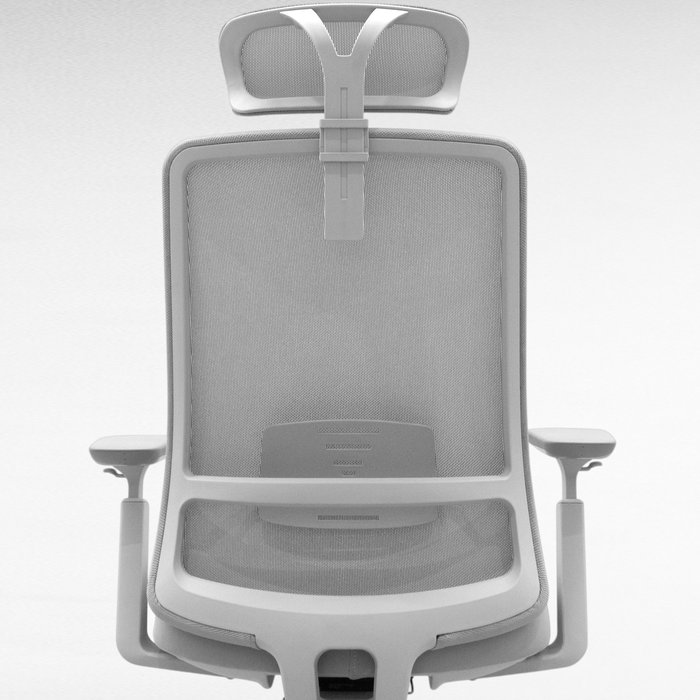
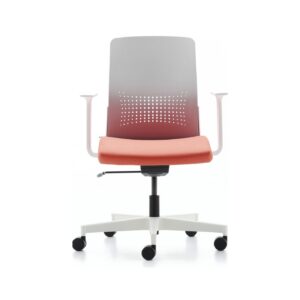
Three things to check when deciding: whether the mechanism moves in synchrony with the sitter, whether lumbar support adjusts in both height and depth, and whether seat depth adjusts to the user. If the armrest height does not clear the desk top, the chair cannot be drawn up to the desk; that is a constraint invisible in a catalogue and obvious on the first day.
The corresponding products are in the task chairs and executive chairs categories, while dimensions and layout are covered in the space planning guide.
Market figures: what each number measures
Combining design psychology with market data carries a risk: the figures in the two fields arrive with very different reliability. This section uses only series with a stated scope, drawn from official or peer-reviewed sources.
| Series | Value | Scope and source |
|---|---|---|
| Global furniture production, 2024 | $768.36bn | All furniture production. Türkiye Ministry of Trade, Easy Export Platform |
| Global furniture production, 2025 forecast | $822.53bn | Expected annual growth of 7.1 %. Same source |
| Türkiye furniture production, 2024 | $17.8bn | Production value. Same source |
| Türkiye domestic market, 2024 | $23.8bn | Domestic market. Same source |
| Exports as a share of production | 14.7 % | Indicator of dependence on the domestic market. Same source |
| Furniture, paper and forest products exports, 2022 | $8.44bn | Not furniture alone; TİM sector group. Damlayıcı and Arslan, 2024 |
There is deliberately no “luxury furniture market” row. The values circulating under that heading come from seven separate research firms, do not agree with one another, and their definitions are not published; a range running from $26.89 billion to $34.44 billion in a single report is a spread of estimates, not a measurement. Kavela reports do not blend series with different definitions into one growth claim.
Türkiye’s position
Türkiye has scale in furniture production and a limited share in exports. According to the 2024 study by Damlayıcı and Arslan, published in MECMUA International Journal of Social Sciences, Türkiye ranked 11th in world furniture exports as of 2022, accounting for roughly 1.7 % of world exports. The same study reports, from the TİM table, that “Furniture, Paper and Forest Products” exports reached $8.44 billion in 2022, or 3.3 % of Türkiye’s total exports.
That last figure is frequently misread: the group is not furniture; it also covers paper and forest products. Isolating furniture requires going down to customs tariff headings; a two-way comparison for 2025 on HS 9401 and 9403 is set out in the H1 2026 report.
The production picture is clearer. According to Ministry of Trade data, 2024 production was $17.8 billion and the domestic market $23.8 billion, with exports accounting for only 14.7 % of production. The sector therefore depends heavily on domestic demand; a structure in which a domestic contraction can be offset by exports has not yet been established.
Aesthetic directions for 2026
Directions are readings of tendency rather than measurement; only those appearing consistently across more than one independent source are included here.
- Quiet luxury. Craftsmanship and material traceability in place of visible branding: natural stone with irregular texture, untreated timber with visible grain, patinated metal, silent mechanisms.
- Warm minimalism and Japandi. Clean architectural lines are retained while the palette moves to earth tones; low-profile furniture and uncluttered surfaces. The intersection of Scandinavian functionalism and Japanese restraint.
- Dopamine decor. A reaction to neutral palettes: vivid colour, curvilinear form and personal expression. In commercial space it works when applied to one controlled zone rather than throughout.
- Biomaterials and structural biophilia. Sustainability moving from a decorative layer to a structural decision: indoor-outdoor continuity established at plan stage, and reclaimed and bio-based materials becoming standard.
What was left out of this report
Several claims present in the first draft were removed once their sources were examined. For transparency, here is what and why:
- Productivity and absenteeism percentages. Figures such as “6-15 % productivity uplift in biophilic offices”, “77 % productivity” and “£3,000 gain per employee per year” traced back to blog posts by firms that sell furniture or biophilic design. None was used, as the primary studies could not be reached.
- Ergonomics figures. “17.7 % productivity increase”, “40 % fewer musculoskeletal complaints” and “$1,685 lost per employee per year” all rested on a single office furniture retailer’s blog post.
- The “clinical study” claim. The statement that users of AI-powered chairs show 28 % less spinal disc compression after six months came from a chair manufacturer’s product page. It is not a clinical study.
- The luxury furniture market table. Removed because it consisted of mutually inconsistent estimates from seven research firms whose definitions are not published.
Data cutoff: 6 September 2026. Sources for all figures are listed below; no value with an unclear scope was admitted to the text.
Sources
- Republic of Türkiye Ministry of Trade, Easy Export Platform — furniture sector analysis
- Damlayıcı, Ö. and Arslan, İ. K. (2024). The Furniture Industry in the World and the Turkish Economy. MECMUA International Journal of Social Sciences, 9(17), 81-91
- A Participatory Interior Design Approach for a Restorative Work Environment, Frontiers in Psychology, 2021
- The Psychological Impact of Instagrammable Cafe Interiors, Universitas Islam Indonesia
- A Focus on Nature: The Attention Restoration Theory
- Biophilic Interior Design: Restoring Attention Through Nature, CSU Monterey Bay
- Designing Interior Spaces According to Environmental Psychology
- Interior Design 2026 Trends, LABASAD
- Kavela, Furniture in H1 2026: The World and Türkiye