







26 June 2026
Meeting Table Comparison: The Right Choice for 6, 8, 10, and 12 People
First Criterion in Meeting Table Selection: Capacity and Purpose of Use. The efficiency of office meeting rooms is directly dependent on the right furniture choice. Especially...
First Criterion in Meeting Table Selection: Capacity and Purpose of Use
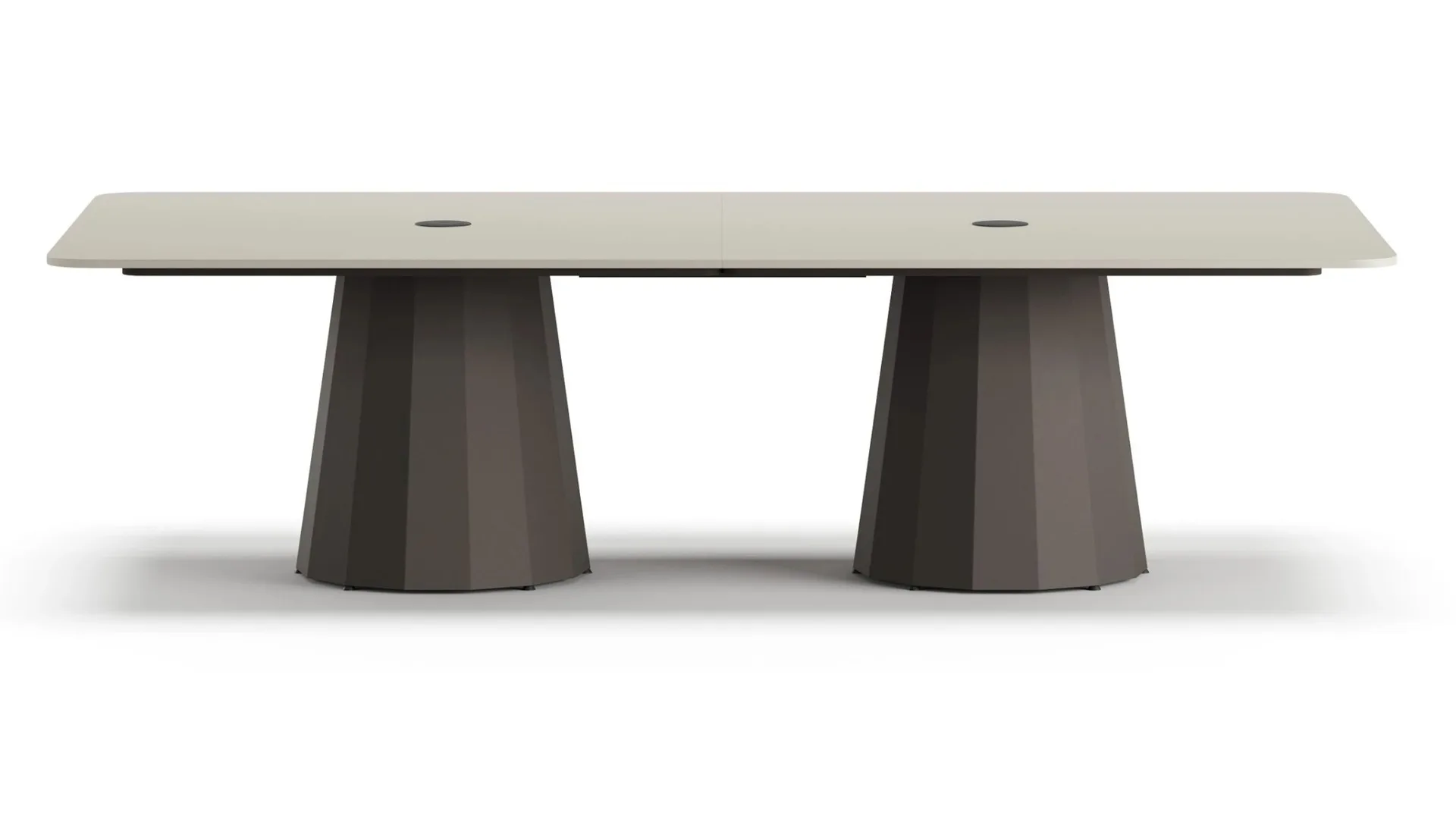
The efficiency of office meeting rooms is directly dependent on the right furniture choice. Especially the meeting table, it is a central element that affects both team dynamics and presentation quality. When choosing between 6, 8, 10, and 12-person tables, it is necessary to evaluate not only the number of people but also the physical dimensions of the table, the effect of its shape on communication style, and its compatibility with technical infrastructure (cable management). In this comparison, we will examine the ideal size ranges, shape advantages, and key factors affecting the budget for each capacity.
6-Person Meeting Tables: Small Teams and Focused Meetings
Six-person tables typically have dimensions ranging from 120 cm x 240 cm to 140 cm x 280 cm. These measurements are suitable for an average room of 15-20 square meters. In narrow spaces, a rectangular form allows for parallel placement against the wall, while oval forms encourage circular communication. On a 6-person table, the length of the table edge per person should be at least 60 cm; otherwise, there will not be enough space for a laptop and notebook. In terms of cable management, a single cable channel is usually sufficient for tables of this size. In mid-segment models, 2 cm thick MDF or particle board material is used, while in the upper segment, 3 cm thick solid wood or tempered glass may be preferred. The price range varies between 5,000 TL and 15,000 TL, depending on the material and mechanism used.
8-Person Meeting Tables: Flexibility for Medium-Sized Teams
Eight-person tables are the most common options, with measurements between 140 cm x 300 cm and 160 cm x 320 cm. This size can host both small department meetings and client presentations. A rectangular form allows for equal participation by seating four people on each side, while a barrel (oval) form ensures that people at the head and foot ends also have full command of the table. The most critical point to consider when choosing an 8-person table is the legroom under the table. While a standard table height is 73 cm, the legroom should be at least 70 cm wide and 60 cm deep. For cable management, most models have two cable entry boxes. For example, some models offering a workspace on top feature 5 cm deep cable channels on the tabletop. In this segment, prices vary between 10,000 TL and 25,000 TL, depending on the quality of the mechanism.
10-Person Meeting Tables: The Standard Size for Meeting Rooms
Ten-person tables meet the standard meeting room needs of most medium and large-scale offices. Their dimensions range from 160 cm x 360 cm to 180 cm x 400 cm. These measurements are ideal for a 25-35 square meter room. Although a rectangular form is the most common choice, for a 10-person table, an oval form might be more advantageous as it does not make it difficult for people sitting at the two ends of the table to see each other. Cable management becomes critical for a 10-person table; there should be at least 3 cable entry boxes on the table surface and an organized cable tray underneath. The table weight in this size ranges from 80 kg to 120 kg; therefore, floor-protective felt feet should be standard. The price range varies between 18,000 TL and 40,000 TL, depending on the material used and the complexity of the design. For example, models in the Quantum series offer specially designed cable management systems for 10-person capacity.
12-Person Meeting Tables: Large Meetings and Boardrooms
Twelve-person tables are preferred for boardrooms and large-scale strategy meetings. Their dimensions range from 180 cm x 420 cm to 200 cm x 480 cm. A room of at least 40 square meters is required for these tables. A rectangular form provides the most efficient use of space for 12 people, while a barrel form creates a more formal atmosphere. On a 12-person table, the space per person should be planned as 70 cm; otherwise, participants will be uncomfortable. Cable management becomes an engineering problem at this size; there should be at least 4 cable entry boxes and 2 power outlets under the table. Table thickness generally varies between 3 cm and 5 cm. The price range varies between 30,000 TL and 70,000 TL, depending on the material and craftsmanship. For example, the Linea model, designed for 12-person capacity, offers integrated cable channels on the tabletop and adjustable height with touch control.
Office Room PlannerCompare 6, 8, 10 and 12-person tables at your own room dimensions.
The Effect of Shape Factor on Communication and Productivity
The shape of the meeting table directly affects the communication style among participants. Rectangular tables encourage a hierarchical structure; people at the head and foot ends naturally assume leadership roles. Therefore, they are ideal for board meetings and presentations. Oval tables, on the other hand, create a more democratic communication environment; all participants see each other at an equal distance. Round tables are the best option for groups of up to 6 people but become impractical for 8 or more people. Barrel-type tables (an oval form close to a rectangle) combine the advantages of both worlds: both a hierarchical order can be established and visual contact is maximized. Research has shown that in a 10-person meeting, an oval table provides 15% more eye contact than a rectangular one.
Cable Management and Technical Infrastructure
In modern meeting tables, cable management is one of the primary selection criteria. While 1 cable box is sufficient for a 6-person table, at least 4 cable entries and 2 power outlets are required for a 12-person table. The cable box depth should be at least 5 cm; otherwise, adapters will not fit. Under the table, a cable tray or cable channel should be present to keep cables organized. Additionally, service covers should be on the underside of the table, providing easy access to cable connection points. For an 8-person table, the price difference between a model with a cable management system and one without can be an average of 20-30%. For example, the X-10 model meets this need with hidden cable channels on the table surface and a removable cable tray underneath.
Material Quality and Durability
The material of the meeting table determines both its appearance and its lifespan. MDF (Medium Density Fiberboard) is the most common material; thicknesses between 18 mm and 25 mm are preferred. Solid wood (oak, walnut) is more durable but heavier and more expensive. Tempered glass tables are preferred in modern offices; 10 mm thick glass can support loads up to 100 kg. Metal legs are generally made of 2 mm thick steel; powder coating provides protection against scratches. While MDF material is sufficient for an 8-person table, solid wood or laminated MDF is recommended for a 12-person table. Laminated MDF is more resistant to moisture and heat; laminate surfaces that pass the 30,000-cycle abrasion test maintain their original appearance for years.
Price Range and Budget Planning
Prices vary greatly depending on capacity, material, and brand. While the starting level for a 6-person table is 5,000 TL, a luxurious 12-person model can reach 70,000 TL. For 8-person tables, an average budget of 15,000 TL can be planned, and for 10-person tables, 25,000 TL. Factors affecting the price include table thickness, leg design (fixed, adjustable, swivel), cable management system, and surface finish (melamine, lacquer, laminate). For example, a lacquer-finished table is 40% more expensive than a melamine-finished one. Additionally, the assembly and transportation of the table should be added to the total cost; the assembly of a 12-person table can take 2-3 hours and may require an extra fee.
Conclusion
In meeting table selection, capacity, shape, and technical infrastructure are interconnected. While 6-person tables offer an ideal starting point for small teams, 12-person tables meet the needs of large organizations. A rectangular form is suitable for hierarchical meetings, while an oval form is suitable for equal participation. Cable management directly affects meeting efficiency, especially for tables of 10 people or more. When determining your budget, you should consider not only the initial cost of the table but also long-term factors such as maintenance and durability. The right choice strengthens internal office communication and ensures more efficient meetings.